Does the 2026 Jeep Cherokee’s standard 4x4 make more difference than the CR-V’s available AWD around Castle Pines, CO?
Fowler Jeep of Boulder - Does the 2026 Jeep Cherokee’s standard 4x4 make more difference than the CR-V’s available AWD around Castle Pines, CO?
When shoppers compare the 2026 Jeep® Cherokee and the 2026 Honda CR-V, a common question surfaces fast: does Cherokee’s standard 4x4 across all trims make a bigger real-world difference than the CR-V’s available Real Time AWD™? Around Castle Pines, CO—where rolling hills, plowed-but-slick arterials, and gravel cut-throughs are part of daily life—that distinction isn’t academic. It shapes how your SUV feels when weather moves in quickly, how it behaves as grades steepen, and how confidently it transitions from dry pavement to a dusting of snow or a rutted shoulder. In short, standard 4x4 means capability is never a checkbox—it’s built-in.
Why standard 4x4 changes the daily drive
Jeep Active Drive I 4x4 is included on every 2026 Cherokee trim, so traction management and torque distribution are always part of the equation. That matters the first time you point uphill on a crowned road with patchy ice, or when a lane change requires climbing across a ridge of slush. The system’s seamless engagement helps the Cherokee feel predictable as surfaces and camber change, without waiting for slip to trigger the response.
By contrast, the CR-V’s available Real Time AWD™ is a welcome assist in wet and snowy conditions and is standard on TrailSport Hybrid and Sport Touring Hybrid. It’s effective, but it isn’t foundational to the entire lineup. If you want all-weather confidence across every trim without shopping for specific packages, Cherokee’s standardization simplifies the choice.
Capability that shows up off the map
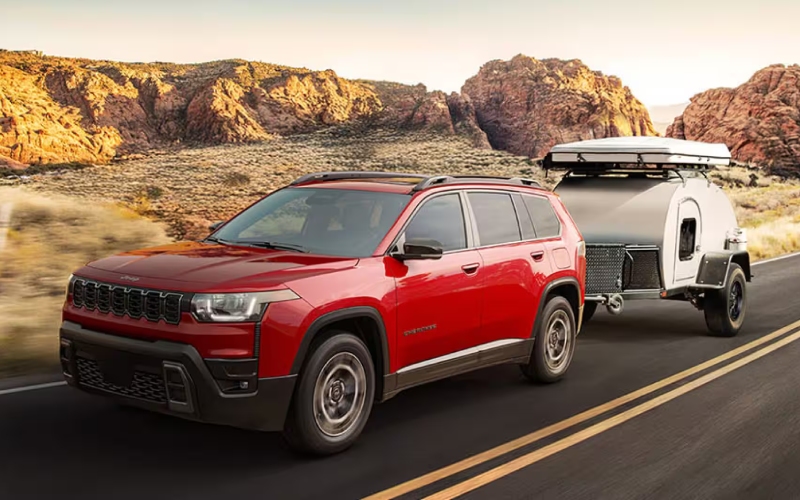
Once you leave manicured pavement, the Cherokee’s advantages grow. Best-in-Class approach and departure angles, up to 20 inches of water-fording capability, and underbody geometry tuned for uneven surfaces add a layer of composure and durability that pairs well with county-maintained roads and the occasional two-track to a trailhead. The CR-V offers light off-pavement confidence—especially in TrailSport Hybrid form—but its strengths remain centered on suburban routes and graded paths.
Powertrain confidence you can feel
The Cherokee’s 1.6L I4 Turbo Hybrid with a 210-horsepower system output blends responsive torque and smooth delivery through a CVT. It’s the kind of power you appreciate on a short on-ramp or as a climb steepens unexpectedly. The CR-V’s hybrid powertrain delivers 204 horsepower across its Sport-flavored trims and feels composed and efficient. On paper, that is a small difference. In practice, the Cherokee’s extra capability—paired with standard 4x4—broadens the envelope for that power to work across more kinds of roads and surfaces.
Technology that supports confidence
Both SUVs serve up modern tech: wireless Apple CarPlay® and Android Auto™ on all CR-V trims, and the Cherokee’s expansive 12.3-inch Uconnect® touchscreen with wireless smartphone integration. Where the Cherokee opens an edge is in visibility and driver assistance. The available 360° Surround View Camera adds a layer of spatial awareness in tight trailhead lots and along narrow shoulders, and the available Digital Rearview Mirror maintains rear visibility even when cargo is stacked high. CR-V shoppers will appreciate Google built-in™ on the Sport Touring Hybrid for native navigation and voice assistance—a strong in-town and highway companion.
Safety suites with different missions
Honda Sensing® is impressively comprehensive: Collision Mitigation Braking System, Road Departure Mitigation, and adaptive cruise are set-it-and-forget-it helpers for everyday driving. The Cherokee comes standard with a semi-autonomous Active Driving Assist System, Full-Speed Forward Collision Warning with Active Braking, Blind Spot Monitoring with Rear Cross Path Detection, Adaptive Cruise Control with stop and go, and Drowsy Driver Detection. Layer those with the 4x4 hardware and off-road geometry, and the Cherokee’s safety story extends into places where conditions shift beyond a well-marked lane or a dry merge.
Use cases around Castle Pines, CO
Consider three scenarios locals know well. First, a pre-dawn commute on packed snow with ruts: the Cherokee’s standard 4x4 and approach geometry help keep the front bumper clear and the wheels tracking straight as you crest plowed ridges. Second, a quick park-and-hike on a graded spur: the 360° camera and ground clearance feel tailor-made for tight turnarounds. Third, a storm cell that drops heavy rain, followed by pooled water: additional sealing and water-fording capability add practical peace of mind. The CR-V handles the first scenario competently—especially with AWD—and does fine on the second and third if conditions remain modest. But if you tend to push beyond modest, Cherokee’s baseline is built for it.
How to decide which SUV fits your drive
Choosing between these two excellent crossovers comes down to where you actually drive—and how much you value capability you do not have to option in. Ask yourself a few focused questions, then test both on routes you know.
- Do you regularly face steep grades, gravel connectors, or shoulders with deep ruts?
- Do you plan to tow a small trailer, drift boat, or pop-up on weekends?
- Will you benefit from top-down visibility tools like a 360° camera in tight spaces?
- Is having 4x4 capability on every trim a must-have rather than a nice-to-have?
If the answers trend toward yes, the 2026 Jeep® Cherokee is likely the better match. If your driving stays almost entirely on well-maintained suburban roads with occasional winter weather, the CR-V—properly equipped—will serve you well.
Frequently Asked Questions:
Is the Cherokee’s 4x4 always active, or do I have to engage it?
Jeep Active Drive I 4x4 manages torque distribution automatically, so you get help seamlessly as conditions change without toggling a setting.
Does the CR-V have a 360-degree camera?
No. The CR-V offers a multi-angle rearview camera, but it does not provide an available 360° Surround View system in the U.S. lineup.
Can both SUVs tow a small trailer?
Yes, but with different ceilings. The Cherokee offers an Unsurpassed-in-Class towing capacity of up to 3,500 pounds when properly equipped, while the CR-V’s towing rating is lower.
Which model gives me the most advanced off-pavement geometry?
The Cherokee. It features Best-in-Class approach and departure angles that support uneven surfaces and steeper transitions than the CR-V is designed to accommodate.
When you are ready to feel the difference firsthand, schedule back-to-back drives on the same day and the same loop—a quick mix of highway, a hilly stretch, and a graded side road. One lap will explain the advantage of standard 4x4 more clearly than any spec sheet. Fowler Jeep of Boulder—serving Golden, Highlands Ranch, and Castle Pines—can help you map a meaningful route and talk through the trims that fit how you live.